Tuesday, July 22, 2008

Zen Zane Floral arranging

For the last several months I have been bringing the altar flowers to my sangha which meets every Monday evening.
When I first started bringing my small token floral arrangements they were somewhat traditional but usually had a little bit of horticultural punch .
Lately I’ve been putting a lot of effort into the floral arrangement and have really enjoyed myself in this new found art form.

I had always admired a well crafted flower arrangement but I was never really WOWED and knocked off my seat until I saw the work of Daniel Ost.
This guy has inspired me to think outside the vase.

Suddenly something inside of me has awakened and now I can’t wait to get up in the morning to scour the garden for flowers, branches, fruits, lichens, mosses, seed pods and even parasite oak tree galls , all to be used in sculpting a floral arrangement .

Tonight for the sangha altar I used a black ikebano metal plate vase, stuck in three Cotyledon flower spikes and then puffed up the base with Aeoniums leaf clusters.
It was very contemporary looking and several people commented on how much they liked it.
I don’t have a photo of it because I gave away all the aeoniums leaf cuttings to my friends but I do have a photo of the cotyledon :


Two weeks ago I brought in a floral arrangement that paired Alstromeria and Canna Pretoria leaves together


I have been enjoying using foliage submerged into a glass vase to hide the stems of the plants.
I’ve used phormium leaves, agave leaves and bromeliad leaves.


I only have two Scadoxus blooming in my back yard right now but I was awfully tempted to cut them for an arrangement with these purple irs ;


Foliage has played a big role in this new found love of the arts affair.
This Acacia cognata has such wonderful angular qualities and its clear blue foliage is a eye catcher. I even love its seed heads.


Next I have to figure out how to do something wild and wonderful with the giant taro leaves !


and these savory sexy succulents too !


I’m having such a fun time !

Sunday, July 13, 2008

To the heart of a garden.

I strongly believe that gardens that resonate with emotion are those that radiate the personality of their owners.

This makes garden making fairly easy for someone who is building a garden for themselves but for garden designers it poses an additional rung on the ladder that must be firmly grasp and felt.

There is a lot of investigated site analysis that must be discovered and solved before a garden designer can set pencil to paper in preparation for the design.

After the technical challenges have been addressed then exploring what is going to create the heart and soul of the project begins.

This explorative process is a highly interpersonal relationship between the designer and the homeowner.
It takes a special set of skills to gently extract information without being intrusive into the life of your client.

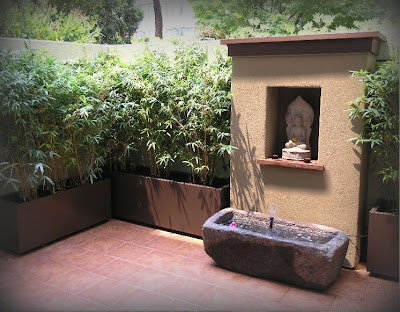
Recently I had the honor to work with a homeowner who has an exquisite collection of fine Asian interior artefacts.
In our conversation together I found that all the artefacts had been passed down through the family over several generations.
Most every item throughout the interior of the house had deep personal emotional attachment and meaning.

As I was developing the design for the outdoor terrace I had a distinct feeling that something was missing.
It occurred to me that this was the only room in the home that did not reflect any real personal history with family as did the rest of the rooms in the house.
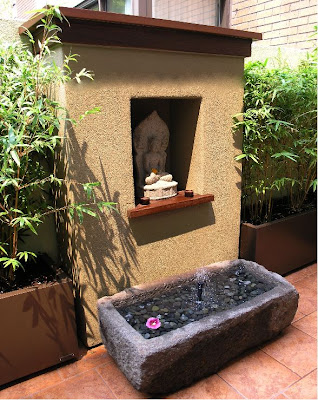
My client and I discussed this sense of emptiness with one another and from this conversation came the realization that there was a deeply loved family buddha that could be sent from Asia to United States that could be placed in the garden to bring a sense of loving family memory into the garden room.

This is the heart of residential garden design, - getting to know your client on a level that you both feel comfortable with so you can help them emote a sense of personal expression.


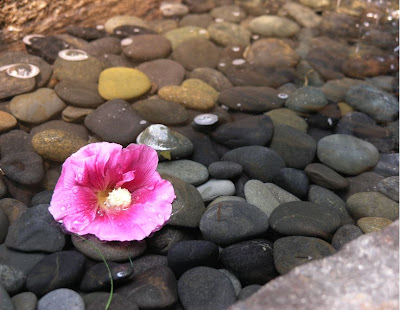
detail of the interior light in the buddha niche


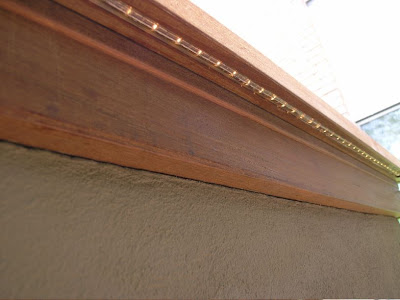
detail of the recessed strip lighting in the ipe wood molding


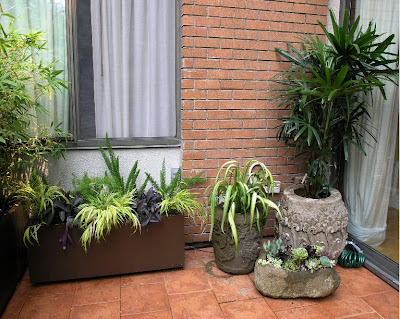
Hand carved Balinese stone pots at the corner that screen the low voltage lighting timer, irrigation timer, hose bib, and venting panel.

Sunday, July 6, 2008

5 Favorite Plants

It was difficult to narrow my choices down to just five of my favorite plants but that was the question that Elizabeth from Garden Rant requested.


# 1 - The Washingtonia robusta ( Mexican Fan Palm ) .
I love it because its wide ribbed palm fronds lend a tropical flavor to the garden and because it is a perfect armature for growing my bromeliad,-
tillandsia and orchid collection on.


which leads me to choice # 2
- The Bromeliad Collection. -
I have been attending the San Francisco Bromeliad Society meetings for the past year. Since attending the once monthly meetings I have learned an incredible amount about this curious looking plant family and my collection has grown substantially. I love that most all of the bromeliads that are in my garden have come from other society members . It is nice to look at a plant in your garden and associate a friend with it.


# 3 The Cussonia paniculata tree ( Snowflake Cabbage tree ) This Dr. Suess looking tress is absolutely fascinating to watch grow ! Its thick corky bark trunk is topped with a glaucaus blue mop head of snowflake looking leaves that can reach 2 feet wide


# 4 The hot pink huge Bougainvillea vine -
This huge brilliant fuchsia colored vine blooms 9 months out of the years


#5 - Aeoniums -
They are my ‘roses’ of choice. With their big leafy rosettes , saucy colors and succulent foliage they add Mediterranean pizzaz to my garden.


Friday, July 4, 2008

Edible Landscapes

Edible Landscapes

Planting an edible landscape is nothing new, it’s been done and done extremely well since the Medieval times.
One of the most beautiful representations of a Medieval vegetable garden was laid out in the 1930’s at The Cloisters in New York City.
Viewing this garden is a great education in understanding how good structural bones can aesthetically and functionally carry a garden through decades and still look as good as the first day that it was planted.

Good landscape architectural bones defines space.
When you think of planting out your vegetable garden it is essentially a garden made up of temporary annuals. When those annuals are gone, you are left with fallow ground.
To anchor your annual garden it makes functional sense to include some structural definition.
Structural definition can be as simple as paths, hedges, arbors and walls of various heights that can be sculpted out of espaliered plants or construction materials ( stone, wood,
metal ).

Below are a few photographs of some sensible edible gardens.

These first two photos show a simple edible estate.
The first photo depicts a garden of Olives, espalier figs, cascading rosemary, lemons and silver ground cover thyme.


This photo of the same property shows a raised vegetable garden specifically designed for a physically challenged ( a broken back ) gardener.


This old photograph was taken in the late 1980’s before I had digital camerea technology. ( apologies for the photographic quality)
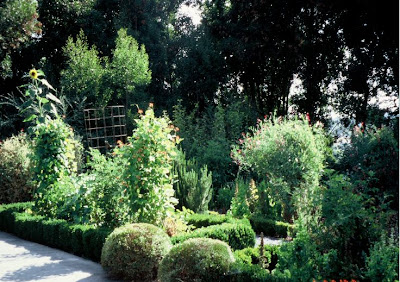
We designed and planted this back yard potager. It’s outer frame structure is defined by clipped dwarf boxwood, variegate myrtle and rosemary topiary forms.
The back green wall is a connecting series of espalier apple trees. This garden provides food all year round for a family of 4.


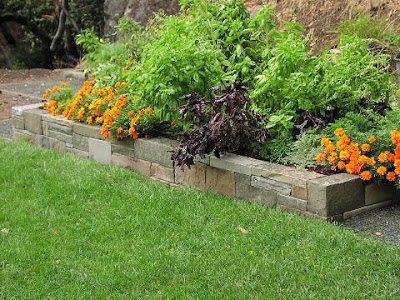
In the 90’s we remoldeled a mid century modernist home. This is one of the raise stone vegetable/ herb/ flowers beds. Hand cut New England bluestone.


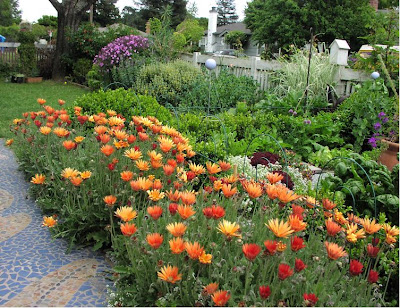
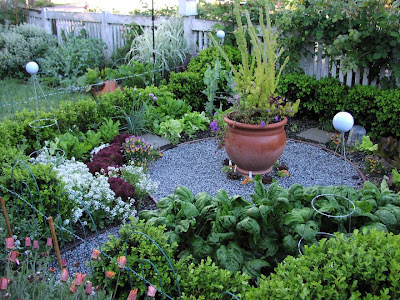
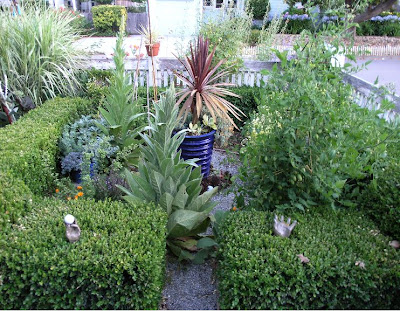
My vegetable / potager garden resides in my front yard.
Because of its front and center location I wanted it to look good all year round so I planned and planted good evergreen bones.

I’m glad that I had the foresight to do this because last year due to medical surgery I was not able to plant any annual vegetables.
It’s depressing enough to deal with failing health so the last thing you want to do is walk into your front yard and see a lifeless fallow garden. That’s not too healing.


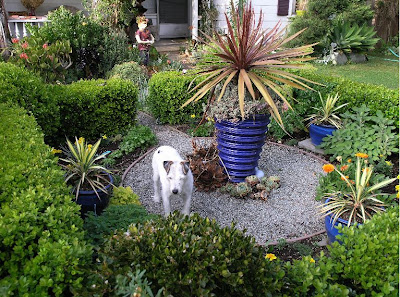
This photo shows the front yard edible garden in its first winter - note the simple wire fence to help train the Jack Russell terrior from foraging in the garden


This picture shows the garden a couple of years later. The boxwood frame is taking shape and the Jack Russell terrior has trained me that he is going to go anywhere he wants in the garden. - gone is the simple barrier fence. He has me trained.


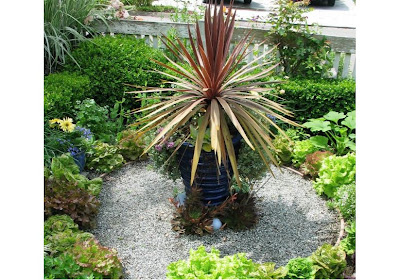
The garden in the late winter - lots of lettuce, peas, chives, and other winter vegs.


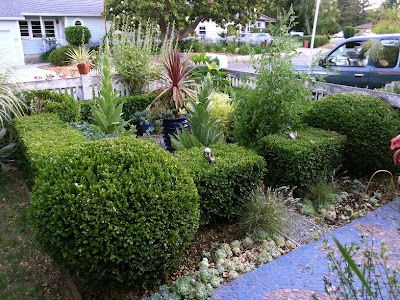
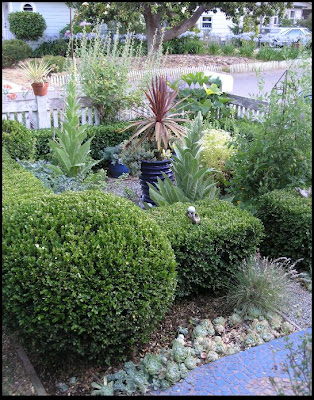
I took this photo July 3, 2008, the bones of the front yard vegetable garden are grown in and now it just takes a trimming twice a year to keep it in shape.
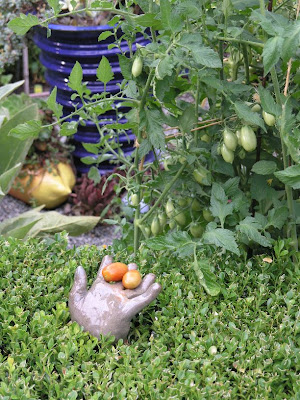
This summer I have tomatoes, squash, peppers, chives, sage, oregano, many types of basil and some medicinal herbs growing.


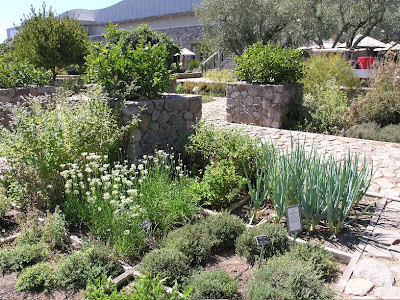
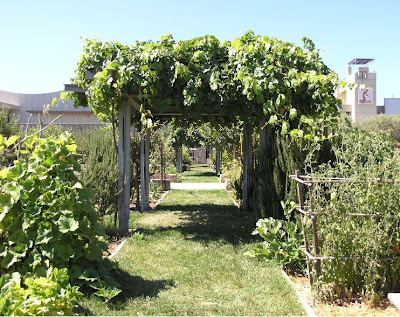
Not too far from my house is the Copia Institute in Napa Valley.
I am crazy over the front yard vegetable garden that Peter Walker designed.
He has said that Villandry in France was one source of inspiration for him when he tackled this design.

Mr. Walker utilizes stone walls, decomposed granit paths, arbors and strong axial vista ways to ground his potager garden to the architecture and surrounding environment.
His planting scheme is spectacular.


Wednesday, July 2, 2008

Drainage systems, bio swales and rain retention / distribution basins.

Drainage. It’s the bane of every landscape designers existence.

Though it sounds like I am whining about having to have to deal with drainage issues, I actually really love the complex challenges that they offer and how they challenge my design and engineering skills.

Because every project is different in its topography, soil profile, budget and functional needs we have used a wide variety of drainage solutions in solving various drainage problems.

Bio -swales have been employed quite a bit when working on down hill slopes to slow surface run off, aid in erosion control and direct water where it is needed.
Below are a couple of projects where swales were use in modest sized residential projects.

A number of switch back swales were used on this Marin County hillside to control surface run off. A series of underground 6 inch diameter drain pipes were used behind stone walls with foundations to take off the hydrostatic stress and re-route the subsurface water to a natural water course at the outer edge of the property.
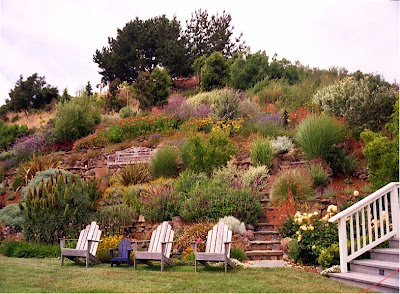

Another project where on contour swales were used to slow down the velocity of surface water runoff and erosion
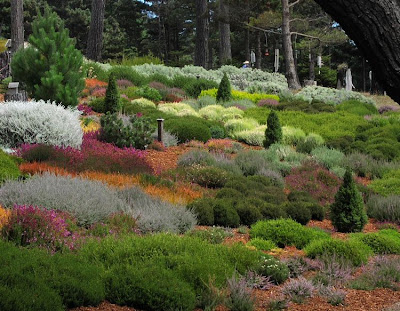

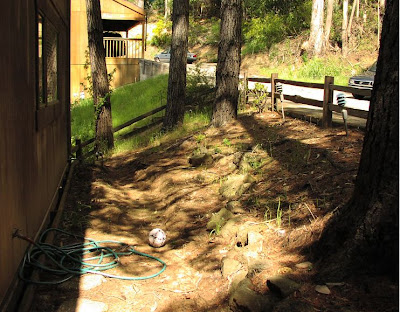
This project as you can see from the before photo had a lot of issues to overcome.
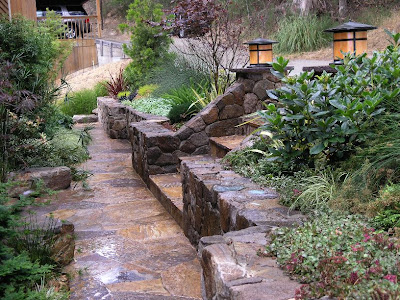
After
The private street that services this small neighborhood has only one street drain inlet and it is almost always non functional because of the dense eucalyptus leaf litter that plugs it up.
Before our landscape renovation, the front yard would take on huge amounts of rain water and silt , right up and into their front door.

We solved this drainage problem with a variety of drainage solutions including improving the street drainage with a channel drain, installing subsurface 6 inch and 4 inch diameter perf and solid pipe, adding a updated french drain system and directing excess subsurface and surface water over to the side hillside and sculpting the topography to slow down the surface erosion and runoff and directing excessive subsurface overflow to a city installed 2 foot diameter open drainage culvert.
This is one of the highest rainfall areas in Northern California. When it rains everywhere else , it is pouring here.

The next project was a great challenge, one that I was extremely grateful that I had a fantastic soils and drainage engineer to collaborate with.
When I looked at this building site with the owner back in July of 97 there was almost 2 feet of sitting water in the far back corner of the property.
This was alarming considering that we had not received any measurable rainfall for the past 2-3 previous months.
The property is a drain sink. It sits squarely at the bottom toe of several converging mountains. It is also surrounded on all three sides by neighbouring homes .
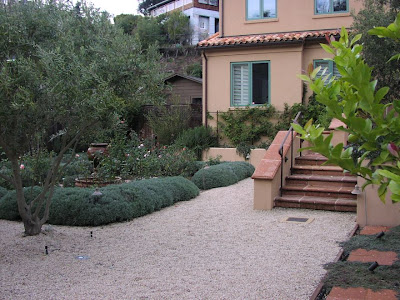
Together we designed a series of giant drainage fields under the gravel paths.
If was calculated by the drainage engineer that each drain field needed to be 7 feet deep and 3 feet wide to handle the amount of water that was received each rainy season.
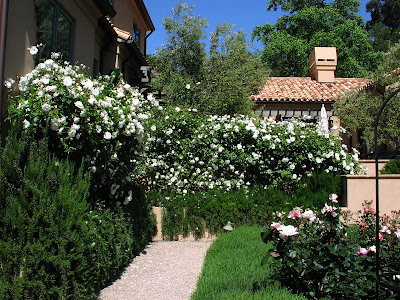
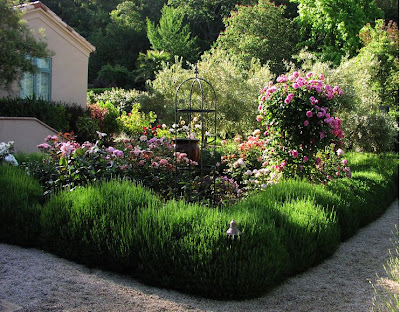
The central rose garden surrounded by the paths and a sitting area is designed to wick up the overflow drainage water . It works on the same theory system as a rain garden.

winter view

spring view

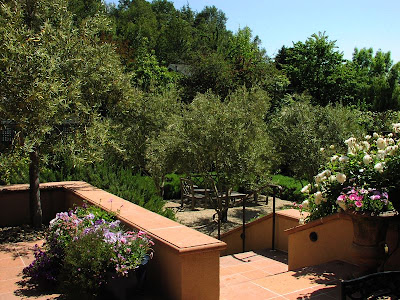
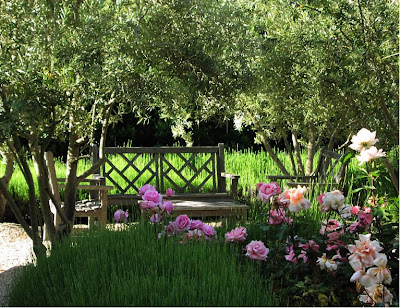
view from terrace above down to sitting area that uses the canopy of 4 olive trees to provide a sense of room and shade. - over looks into the rose garden.

same view different season
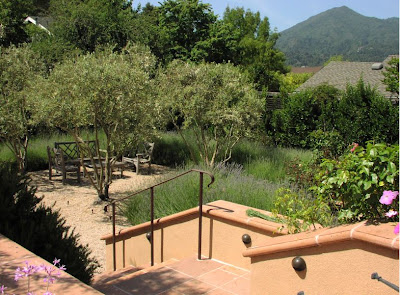

Central rose garden / rain garden - receives subsurface runoff

sitting area


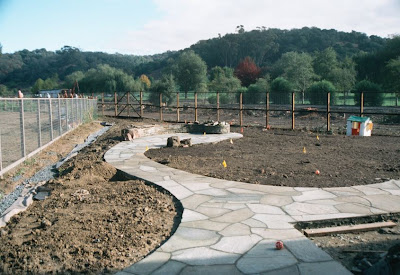
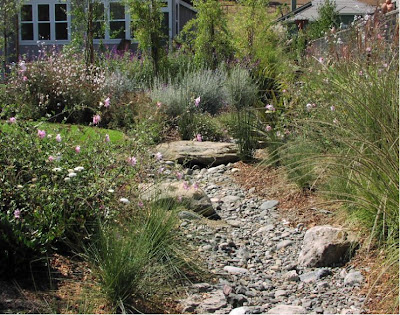
This newly developed suburban neighborhood was poorly graded by the developers.
Our clients property took on the surrounding drainage from 5 adjoining properties.
We used drainage swales, subsurface drain pipes and a series of extending sub surface perf pipe to redistribute the water within our clients property in order to comply with city ordinance but also to effectively spread the water out evenly over a period of time .
Only when the system hits its point of refusal does the excessive subsurface drain water fall into a secondary swale system that is maintained by the city.


This a last project was build in Napa Valley.
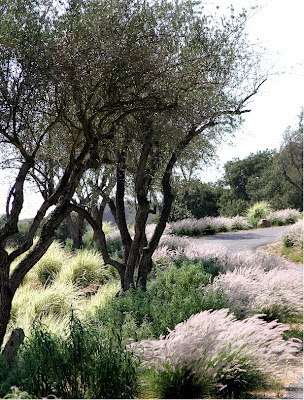
The portion of this project is rather small in comparison to the rest of the project that was installed but is represents some good examples of drainage work using on contours swales, retention basins , and sub surface piping work.

I’ll let the photos tell most of the story but to give you a sense of scale, those are 60 to 80 year old olive trees that were planted that had root balls of approximately 12 to 14 round and 3 to 4 feet thick. - Only two could be loaded onto to a large size flat bed.
There were 27 of them installed across a very steep hill that had to comply with wetland restoration ordinances as well as vineyard installation ordinances. Lots and lots of legal paper work, planning commissions and oversight review boards to work with.
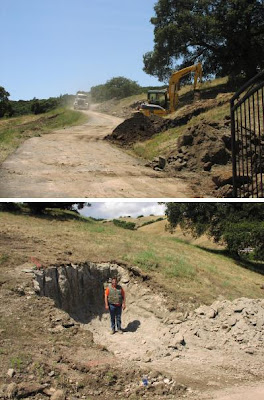

The flat bed delivering two olive trees at the bottom of the entry drive.
On contour swales can be seen traversing across hill.
Perf and solid 4 inch pipe is drainage leading out from the planting holes from the olive trees into a lower swale.
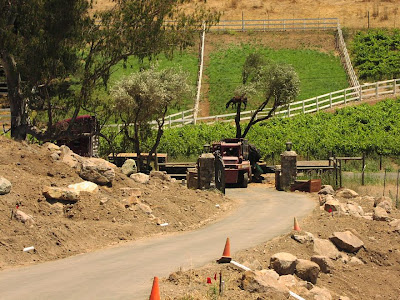


Photo taken from the vineyard beyond. Wetland in the foreground, hill stabilization in the midground with native grass seed sprouting between erosion jute. On this down hill slope not too much on contour swales were used as there were on the upper hillside.
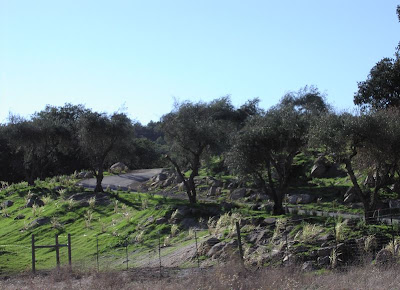

View the end of the first summer looking up the driveway.
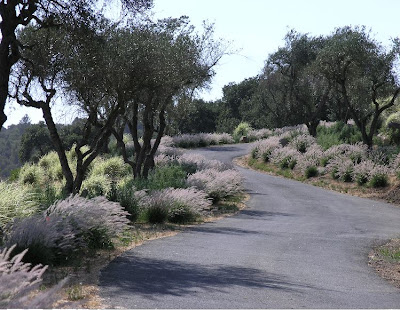

Olives, Salvia leucantha, Miscanthus sinensis variegata and Pennesetum .